Free, practical guides written by our training team — from manual handling and lifting technique to fire safety, first aid and food hygiene. Learn the essentials, then get certified in minutes.
Our online safety courses are benchmarked to the requirements of:

Most workplace injuries linked to lifting and carrying are not freak accidents — they are predictable, repeated and, with the right approach,…
Read article →
Most employers know manual handling training is a good idea. Far fewer realise that skipping it is a legal gamble where the downside runs into…
Read article →
Every Irish employer whose staff lift, push, pull or carry has legal duties around manual handling — but the rules are often misunderstood. This…
Read article →
Lifting, carrying, pushing and pulling are part of almost every job in Ireland. Manual handling training turns those everyday tasks into something…
Read article →
"What's the maximum weight I'm allowed to lift at work?" It is one of the most common manual handling questions in Ireland — and the honest answer…
Read article →
Helping someone out of bed, onto a chair or off the floor is one of the most physically demanding jobs in Irish healthcare — and one of the…
Read article →
Few sectors put as much strain on the human body as warehousing and logistics. Pickers walk miles a shift, lift from floor to shoulder height, and…
Read article →
Most back injuries at work do not come from one heroic lift gone wrong — they build up from years of lifting badly. The good news is that a safe…
Read article →
Before anyone lifts a single load, a good manual handling routine starts with a quick mental check. TILE is the four-letter prompt that makes that…
Read article →
Ladders are the most familiar piece of access equipment on any Irish site — and one of the most misused. Used correctly they are perfectly safe…
Read article →
A fall takes a fraction of a second and can change a life forever. The controls that reliably prevent falls are well understood — the challenge is…
Read article →
If your staff ever climb a ladder, stand on a platform or work near an edge, the law in Ireland places clear duties on you. This article explains…
Read article →
Falls from height remain one of the most serious causes of workplace injury in Ireland. The good news is that almost every fall is preventable…
Read article →
Abrasive wheel injuries are rarely freak events. They follow a small set of predictable causes — and each one has a well-proven control.…
Read article →
There is no single regulation in Ireland titled "abrasive wheels". Instead, the duties sit within the broader work-equipment rules. This article…
Read article →
Angle grinders and bench grinders are everywhere in Irish workshops, garages and construction sites. They are also among the most dangerous hand…
Read article →
More abrasive wheel injuries trace back to a faulty mounting than to the cutting itself. Get the fitting right and most of the danger disappears.…
Read article →
Asbestos was banned in Ireland years ago, yet it still sits quietly inside thousands of older buildings. If you work in construction, maintenance…
Read article →
Irish asbestos law is clearer than many employers assume. If you manage premises, run a trade business or supervise staff in older buildings, here…
Read article →
Asbestos-related illness is one of the cruellest occupational risks because the harm is invisible for decades. Understanding how the fibres damage…
Read article →
What puts out one fire can make another explode. Understanding the classes of fire is the simplest way to make sure you reach for the right…
Read article →
If you employ people or control a building in Ireland, fire safety is a legal duty with real teeth. Here is a clear breakdown of who is…
Read article →
A workplace fire can take everything in minutes. This complete guide explains how Irish employers prevent fires, plan for escape and meet their…
Read article →
A fire extinguisher in the right hands can stop a small fire becoming a catastrophe — but only if it is the correct type and used safely. Here is…
Read article →
Behind every smooth evacuation is a trained fire warden who did the quiet work beforehand. Here is exactly what the role involves, day to day and…
Read article →
When a heart stops, the people nearby decide the outcome long before paramedics arrive. Here are the CPR and defibrillator basics every trained…
Read article →
Every Irish workplace, from a two-person office to a busy warehouse, has a legal duty to make sure an injured or suddenly ill person can be helped…
Read article →
"How many first aiders do we need?" is one of the most common safety questions Irish employers ask — and the answer is not a single number. Here…
Read article →
Looking after a colleague's mind is as much a part of workplace welfare as looking after their body. Here is a practical, jargon-free guide to…
Read article →
The wrong PPE can be worse than none at all — it gives a false sense of safety while leaving the real hazard untouched. Selecting equipment well…
Read article →
Personal protective equipment is the last line of defence against workplace hazards — and in Ireland the law sets out exactly when and how it must…
Read article →
A permit-to-work is the document that turns good intentions into a controlled, checked, accountable confined space entry. Here is how the system…
Read article →
A confined space can look harmless and still take a life in seconds. Understanding what counts as one — and why they are so dangerous — is the…
Read article →
When something goes wrong in a confined space, seconds matter — and the instinct to rush in unprepared has killed more rescuers than victims. A…
Read article →
If your team lifts, carries, pushes or pulls as part of the job, Irish law expects you to assess the risk before injuries happen. A manual…
Read article →
A risk assessment is the foundation of every safe workplace in Ireland — and the law requires one. Here is how to produce a clear, practical…
Read article →
Risk assessment can feel daunting, but it follows a simple, repeatable pattern. Break it into five clear steps and any competent person can…
Read article →
The safety statement is the document that sets out, in writing, how your organisation manages safety. In Ireland it is not optional — it is a…
Read article →
For some customers, a single mistake with an allergen is not an inconvenience — it is a genuine emergency. Getting allergen information right is…
Read article →
Temperature is the single most powerful tool a food handler has against harmful bacteria. Get the numbers right and most food poisoning risks…
Read article →
Behind every safe meal served in Ireland sits a clear framework of law and oversight. Knowing how the FSAI, Environmental Health Officers and EU…
Read article →
HACCP can sound like industry jargon, but at its heart it is just a structured way of thinking about food safety. If you run a café, restaurant,…
Read article →
Policies and procedures keep you compliant. Culture keeps people safe when no one is watching. Here is how to build a safety culture that becomes…
Read article →
Online training has transformed how Irish businesses keep their teams compliant — but not all platforms are equal. Here is what actually matters…
Read article →Self-paced, HSA-aligned, available in 20 languages. Pass the short assessment and download your certificate the same day — valid for 3 years.
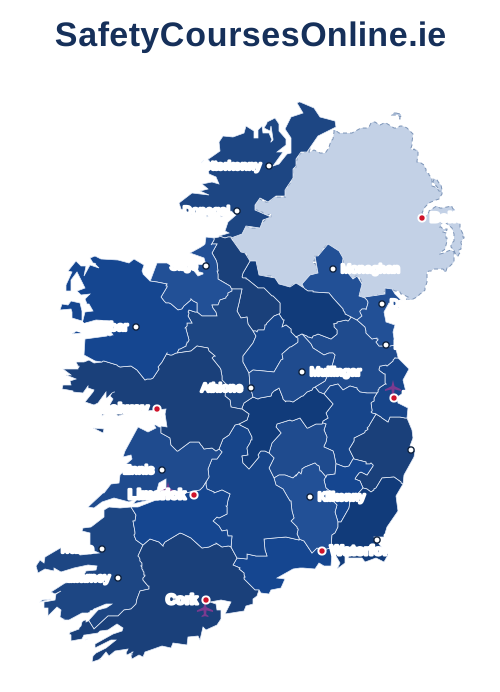
Take your course online from Dublin, Cork, Galway, Limerick, Waterford, Sligo - or any town in Ireland. Learn at your own pace on any device, and finish with a certificate from Safety Courses LLC once you pass the assessment.